
On this oh so fitting day, commonly associated with all things scary, I bring you updates from the land of all things scary– SURVEY RESULTS!
Eventually I will post all of the results on here, but for now, I am going to show you some interesting differences between the men’s results and the women’s results.
Going into this, I expected some differences between the genders, of course, but what I got actually surprised me more than I originally thought possible– there were very few differences between the two gender groups. On a relative side note, I did have a user ask for there to be an additional option of “other” for gender, and had the survey not started I would have happily added that option, but once the survey began, editing it would alter the results and make those who took the survey before the changes’ results invalid. I had a theory that men would be harder to scare than women, and that theory held true. When needing to rate images and stories on a scale from 1 to 5 (1 being not scary, 5 being terrifying), men averaged at 3.5, while women averaged at 3.9.
In response to scary images, men averaged at 3.2, while women averaged at 3.7– which is the biggest gap in this category. The most interesting result in this category was the response to the two sentence scary stories. One would think that a visual stimulus would prove to be more frightening, but at an overall average of 3.9 (3.8 for men; 4 for women), the sentences proved to be the more frightening option.
I did mention in the introduction that I believe that, “It is no longer the superficial gore and appearances that chill our bones, but the psychological state of mind we are capable of being forced into.” The image-less sentences allow our minds to fill in what we cannot see, which means your entire imagination is open to play– worst fears and all. Earlier in the survey, I asked “Would you rather be unable to see, or unable to hear?”. Over 90% of users chose to be unable to hear, meaning that being unable to see is more terrifying option. We have reached a point where visual stimuli are no longer the things that scare us. Television, movies, and video games have tapped that source dry. All of those images just store somewhere in our minds, mixing and morphing with our fears, worries, dreams, and memories to create a much for frightening stimulus– our imagination.
The first major disagreement between the genders was deciding which “Other Monster” was most frighting. The options were clowns, dolls, aliens, sharks, and artificial intelligence.  As you can see, overall dolls take the cake, if only ever so slightly over clowns. But when it came down to the men, clowns took the lead. To me, these results make sense. Growing up I had many dolls and the thought of them being evil creatures definitely crossed my mind more than once (Thank you, creators of Chuckie). The thought of toys that we love and care for (…and have in our bedrooms where we sleep…) suddenly coming to life and killing us probably comes to mind more frequently than the occasional homicidal, creepy-ass clown. However most men did not have dolls, so I can understand clowns taking the cake on this one. Anyone down for a Clowns V. Dolls horror flick?
The next disagreement came with the question “Would you rather find a man hiding in your closet or in the backseat of your car?” While overall, users picked car for their choice of hiding spot, deeming the closet the more frightening place to find a stranger, men actually thought the opposite.  During the survey, I left a space where users could explain why they chose what they chose. One man wrote, “I can’t jump out of a car, but I can jump out of my room.” Another man answered, “Cars are a dangerous place to be attacked. You could really hurt someone if you swerve off the road. Only person getting hurt in my closet is me. Also, who wants to be attacked from behind?” Men seem to think ahead to the escape route, or ahead to the consequences, while women think about the situation itself. One woman wrote, “It’s scarier to think about how a stranger got into my house and then my room and then my closet than it is to think about someone breaking into my car,” while another said, “There’d be more questions that I would need to find answers to if the man had been found inside my closet.” I personally was reminded of the scary story/urban legend The Backseat Killer (sometimes known as High Beams), so I chose closet.
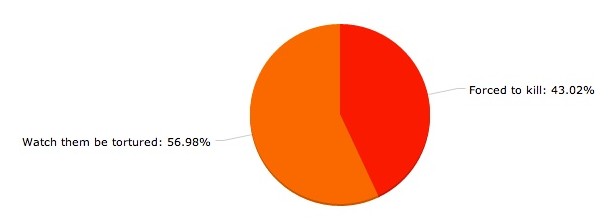
The last results that did not match up was also the one that puzzled me most. The question was “Would you rather be forced to kill a love one or watch them be tortured?” Now, I admit this was probably one of the least pleasant questions on the survey.

It even took me quite a bit of time to answer it. Overall, users determined that they would rather watch a loved one be tortured than be forced to kill them, but the margin of difference was 53/47, making it an incredibly close call. The question that you really need to answer with this question is which is worse– suffering or death? This question breaches all subjects– religion, philosophy, psychology, etc. Men decided that watching the one they love be tortured was worse than having to end their life, while women felt the opposite. Poetically, I guess, my mind goes to the idea that women are physically designed to bring life into this world, not take it away, while men are physically designed more (larger, stronger) to be the protectors of life, so the goal would be to prevent pain and suffering. I will let the users speak for themselves, though:
Women on why they’d rather watch than kill:
- Maybe they could still survive and be with me in the end — and I’d have less guilt on my conscience.
- There would always be the hope of being able to save them.
- Because they would live, hopefully.
- There’s hope I can get them out.
- Same as before; there’s still a chance of getting them out alive.
- Because there’s a chance they’ll live
Men on why they’d rather kill than watch:
- If they were being tortured to death, I would choose to kill them, but if I knew there was a chance for survival I would watch them suffer.
- I can end it.
- Less pain.
- Quick
Those were the only four men who chose to explain why they chose what they chose. The silence of the other men is not surprising and leads me back to the idea that this answer is more intrinsic and instinctual than anything.
So that was the first instalment of the survey results! Sorry to end on such a downer! Thanks again to all of the participants of my little survey. The final count was 165– 116 of which braved the test until the very end.
Sweet Dreams,
EAP
 Elizabeth A. Petersdorf